Autopost
A full-stack social media management SaaS that enables creators and agencies to schedule, automate, and publish content across multiple platforms.
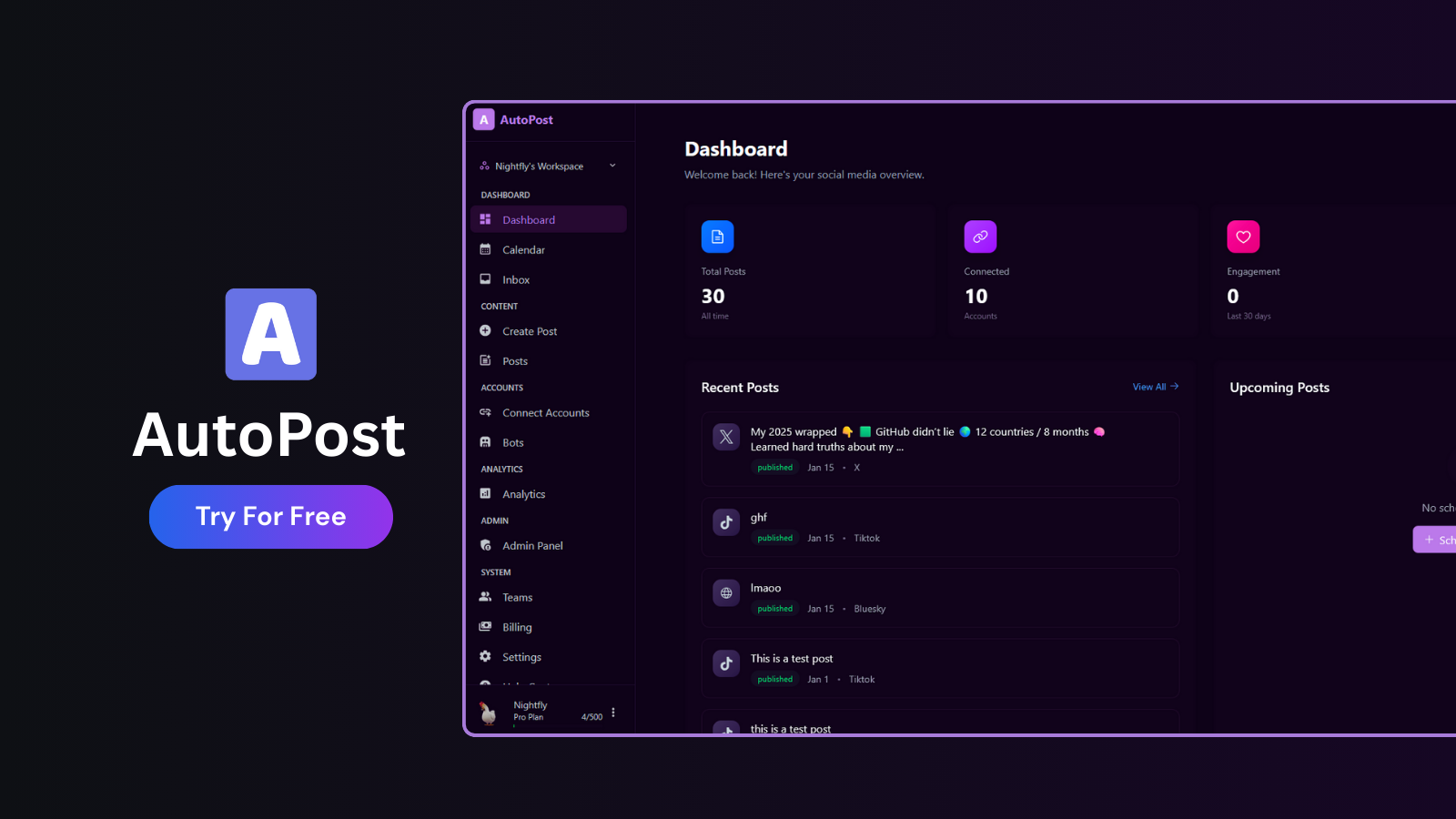
Overview
Client: AutoPost.gg
Project Duration: March 2025 – July 2025 (6 Months)
Services: SaaS Development, Product Design, UX Research, Full-Stack Development
The Challenge
AutoPost.gg was built to solve one of the biggest pain points for creators, businesses, and agencies: managing multiple social media platforms from a single place.
While many scheduling tools already existed, they all shared a common limitation—agencies and virtual assistants often required direct access to creators' social media accounts, forcing users to share passwords or login credentials.
The goal was to build a modern SaaS platform that simplified content management while introducing a more secure way for agencies and creators to collaborate.
Research & Strategy
Before development began, I researched existing social media management platforms, agency workflows, and creator tools to understand where competitors fell short.
The biggest opportunity wasn't simply faster scheduling—it was improving collaboration between creators and agencies.
This led to one of AutoPost's core differentiators: agencies can request access to creator accounts through official platform permissions, allowing them to create, edit, schedule, and publish new content without ever receiving the creator's passwords or gaining access to historical content.
The result is a workflow that is both more secure and significantly easier to manage.
Building a Modern SaaS Platform
AutoPost was developed as a subscription-based SaaS application with scalability and automation at its core.
Users can connect multiple social media accounts into a single dashboard where they can:
Create content once
Automatically adapt posts for each platform
Schedule future posts
Publish across multiple social networks
Manage multiple brands and workspaces
Collaborate with teams and agencies
The platform supports creators, businesses, and agencies managing content across multiple platforms from one streamlined workflow.
AI & Automation
A major focus of the platform was reducing repetitive work through automation.
The platform includes AI-powered tools that help users:
Generate content
Adapt posts for different platforms
Create AI-generated images
Optimize hashtags and formatting
Automate publishing workflows
Build reusable AI profiles with custom writing styles
By combining multiple AI services into one platform, users can significantly reduce the time spent creating and publishing content.
Beyond Social Scheduling
To encourage long-term engagement, AutoPost was designed as more than a scheduling tool.
The platform includes:
SEO-optimized blog system
Educational resources
Productivity tools
Creator utilities
AI-powered features
Returning user experiences
These features support both organic search growth and user retention by giving visitors reasons to return even when they aren't actively scheduling content.
Platform Features
Over six months of development, the platform evolved into a complete SaaS product featuring:
Subscription billing
User authentication and management
Multi-workspace support
Affiliate program and dashboard
CRUD account management
Social media integrations
Automated scheduling
AI content generation
AI image generation
Team collaboration
Role and permission management
Analytics
Blog CMS
SEO-optimized marketing website
High-performance frontend
Results
Today, AutoPost.gg serves 200+ active users and provides a scalable foundation for continued growth.
The platform successfully combines:
A modern SaaS subscription model
Secure creator-agency collaboration
AI-powered content creation
Multi-platform publishing
SEO-driven customer acquisition
Built-in retention features that encourage repeat usage
The project demonstrates how thoughtful product design can differentiate a SaaS product in a highly competitive market by solving real workflow problems instead of simply replicating existing tools.
My Role
I led the project from product strategy through design and full-stack development.
This included researching competitors, designing the user experience, architecting the SaaS infrastructure, building the frontend and backend, integrating AI services, implementing subscription billing, developing automation workflows, and creating the SEO-focused marketing website.
The result is a production-ready SaaS platform that combines modern UX, scalable architecture, AI automation, and secure collaboration into a single product built for creators, businesses, and agencies.